Friday, April 17, 2009
In the strange city of Lahore
It was always tea-time in Lahore
Good old days when we all love to read Hatim Tai Delhi mai, Hatim Tai Labnan mai, Hatim Tai london mai, Ameer Hamza Maidanai Jung mai and all about Shansha-i-Afrasayab, Umr-o-Ayyar , Buzurj Mehar etc. It was the same famous urdu writer A Hamid now taking us to the ancient Lahore, a city which resembles Baghdad of Harun Rashid or Bazara-i-Hameedia of Damasqus or Khan Khalieli of Cairo , shadows of history,romance and nostalgia down to the memory lane of past 5000 years !
Lahore Lahore Aye: It was always tea-time in Lahore
By A Hamid
My old Lahore is Lahore as it was on the eve of partition and in the first few years after independence. The pre-Pakistan Lahore is vivid in my memory. I remember walking through the narrow bazaars of Shah Alami where the agreeable smell of foodstuffs and produce was always in the air. So narrow were some of the streets that I once saw a tonga getting stuck in one of them. The scene changes. I am standing outside Lohari Gate. A slim young man with blond curly hair wearing a brown suit shakes my hand: he is the Hindi poet Raj Baldev Raj.
As you entered Anarkali, to your left was a Sikh-owned sweetmeat shop whose lassi was much prized. The only hotel in Anarkali I remember is Nizam Hotel and its big sign. Close to where the Lahore Hotel stood, there was a Hindu-owned hotel whose name I do not recall. Actually, it was more a dhaba than a hotel. There were tiny wooden cabins where customers sat and where I once saw the famous humorist and newspaperman Haji Laq Laq. In Gowalmandi Chowk, if one approached it from the Islamia College side, there was another hotel with a sign that said, “Drinking permitted on the premises.” I never went inside. Another place I remember was a teashop on Fleming Road where tea used to be prepared on coal-fired braziers, the owner sitting cross-legged on a jute mat. There were a couple of tables and chairs inside the shop. The magazine Shahekar, where Raj Baldev Raj and I worked, had its office in a street facing that teashop and it was convenient for us to come here for a hot cup. The mixed tea –called dhood patti these days – served there was delicious.
I can recall every Lahore hotel and restaurant from the early days of Pakistan. Let me begin with Pak Tea House. When I first saw it, I noticed that its sign had been crudely painted over. The word India had been replaced with Pak. I don’t know how Pak Tea House became the hangout of Lahore’s writers. In late 1947 or perhaps mid-1948, four brothers - Alim, Siraj, Sadiq and Hamid - who were refugees from India got India Tea House and Cheney’s Lunch Home allotted in their names. Sadiq got the Cheney’s Lunch Home, though it was Hamid who ran it, while Siraj and Alim ran what they renamed Pak Tea House. Alim was the keeper of my secrets because some girls used to phone me here. He was a man of literary taste and if Nasir Kazmi or Shohrat Bokhari arrived late some morning, I would drink my first cup of tea with Alim, which he would prepare with great aplomb. A small radio on the counter used to be tuned to the listeners’ request programme from the Lahore station.
Off and on, some professors from Government College,Lahore and a few students, including girls, would drop in for a cup. Everyone minded his or her own business and if a girl came looking for her friend, nobody showed any sign of jealousy. The regulars included Ashfaq Ahmed, Munir Niazi, Anjum Roomani, Qayyoom Nazar and Sajjad Baqar Rizvi. We would spend most of our time here, only going for a walk through Anarkali or down the Mall now and then. The violence of partition was still very fresh in our memories and people would talk about the horrors they had seen. I remember Nasir Kazmi saying, “There used to be a shady neem (margosa) tree in our courtyard in Ambala and it would bear fruit in spring that we would eat with great relish. On the roof-top, I had pigeons of every variety. Before we left, I set all the birds free, but when I took a last look at our home before turning the street corner, I found all of them perched on the parapet.”
Coffee House across the street had its own crowd, mostly made up of lawyers, politicians and journalists. The atmosphere was intellectual and journalistic. Conversation used to revolve around politics and newspapers and their editorial policies. The leading lights of Coffee House were Maulana Chiragh Hasan Hasrat, Abdullah Butt, Riaz Qadir, Jamiluzzaman and Meem Sheen. Sometimes, Hamid Nizami would saunter in. Before Pakistan, it was India Coffee House but India had been painted over with the word Pakistan.
While Nasir Kazmi would walk across from Tea House to chat with Riaz Qadir, I would stay away because - having known the far superior coffee of Rangoon, Pondicherry and Singapore - I did not like the coffee with the burnt taste it served. Abdullah Butt’s wit was famous. He was a sparkling conversationalist, as was, of course, Hasrat. Once when Hasrat’s order had been delayed inordinately, the manager asked him if it was the white-bearded waiter he had placed his order with. “Maulana,” replied Hasrat, “when I placed my order, his beard was black.” The Coffee House is long gone and it is only the memory of the place and those who frequented it that a few of us still retain.
Then there was the Nagina Bakery which was the hangout of Lahore’s intellectual heavyweights such as Maulana Salahuddin Ahmed, Dr Syed Abdullah, Dr Ashiq Hussain Batalvi, Bari Alig and Abdullah Qureshi. It did not survive for long after partition. The famous Lahore restaurant Lorang’s on the Mall was a cool and sophisticated place. It served the best tea in town and was one of Hamid Nizami’s favourite haunts. Its closure was a sad day for the city. Shezan was an aristocratic place and so was its clientele. The Pak Tea House crowd stayed away from these places. Anwar Jalal Shamza lived right behind Shezan and he it was who had designed the Shezan lettering that is still in use. The S was identical to the S with which he signed his paintings. There was also Stiffles, which was a popular bar before partition. It is the same site that made way for Casino and Lord’s in the 1950s and 1960s. In the Regal Chowk, there stood the famous Standard, owned by a Hindu gentleman everyone called Paul. Across the road was another popular restaurant of the 1960s: Gardenia. Where Wapda House now stands, once stood Metro, where there was ballroom dancing on weekends. The famous cabaret dancer, the lovely Angela, used to perform there. To beat the prohibition, beer was served in teapots. None of the restaurants that I have written about are any longer in existence. Today there is not even one decent tea place in Lahore, which says something about the city and how it has changed. Who would say it has changed for the better?
A Hamid, distinguished Urdu novelist and short story writer, writes a column every week based on his memories of old Lahore. Translated from Urdu by Khalid Hasan
Good old days when we all love to read Hatim Tai Delhi mai, Hatim Tai Labnan mai, Hatim Tai london mai, Ameer Hamza Maidanai Jung mai and all about Shansha-i-Afrasayab, Umr-o-Ayyar , Buzurj Mehar etc. It was the same famous urdu writer A Hamid now taking us to the ancient Lahore, a city which resembles Baghdad of Harun Rashid or Bazara-i-Hameedia of Damasqus or Khan Khalieli of Cairo , shadows of history,romance and nostalgia down to the memory lane of past 5000 years !
Lahore Lahore Aye: It was always tea-time in Lahore
By A Hamid
My old Lahore is Lahore as it was on the eve of partition and in the first few years after independence. The pre-Pakistan Lahore is vivid in my memory. I remember walking through the narrow bazaars of Shah Alami where the agreeable smell of foodstuffs and produce was always in the air. So narrow were some of the streets that I once saw a tonga getting stuck in one of them. The scene changes. I am standing outside Lohari Gate. A slim young man with blond curly hair wearing a brown suit shakes my hand: he is the Hindi poet Raj Baldev Raj.
As you entered Anarkali, to your left was a Sikh-owned sweetmeat shop whose lassi was much prized. The only hotel in Anarkali I remember is Nizam Hotel and its big sign. Close to where the Lahore Hotel stood, there was a Hindu-owned hotel whose name I do not recall. Actually, it was more a dhaba than a hotel. There were tiny wooden cabins where customers sat and where I once saw the famous humorist and newspaperman Haji Laq Laq. In Gowalmandi Chowk, if one approached it from the Islamia College side, there was another hotel with a sign that said, “Drinking permitted on the premises.” I never went inside. Another place I remember was a teashop on Fleming Road where tea used to be prepared on coal-fired braziers, the owner sitting cross-legged on a jute mat. There were a couple of tables and chairs inside the shop. The magazine Shahekar, where Raj Baldev Raj and I worked, had its office in a street facing that teashop and it was convenient for us to come here for a hot cup. The mixed tea –called dhood patti these days – served there was delicious.
I can recall every Lahore hotel and restaurant from the early days of Pakistan. Let me begin with Pak Tea House. When I first saw it, I noticed that its sign had been crudely painted over. The word India had been replaced with Pak. I don’t know how Pak Tea House became the hangout of Lahore’s writers. In late 1947 or perhaps mid-1948, four brothers - Alim, Siraj, Sadiq and Hamid - who were refugees from India got India Tea House and Cheney’s Lunch Home allotted in their names. Sadiq got the Cheney’s Lunch Home, though it was Hamid who ran it, while Siraj and Alim ran what they renamed Pak Tea House. Alim was the keeper of my secrets because some girls used to phone me here. He was a man of literary taste and if Nasir Kazmi or Shohrat Bokhari arrived late some morning, I would drink my first cup of tea with Alim, which he would prepare with great aplomb. A small radio on the counter used to be tuned to the listeners’ request programme from the Lahore station.
Off and on, some professors from Government College,Lahore and a few students, including girls, would drop in for a cup. Everyone minded his or her own business and if a girl came looking for her friend, nobody showed any sign of jealousy. The regulars included Ashfaq Ahmed, Munir Niazi, Anjum Roomani, Qayyoom Nazar and Sajjad Baqar Rizvi. We would spend most of our time here, only going for a walk through Anarkali or down the Mall now and then. The violence of partition was still very fresh in our memories and people would talk about the horrors they had seen. I remember Nasir Kazmi saying, “There used to be a shady neem (margosa) tree in our courtyard in Ambala and it would bear fruit in spring that we would eat with great relish. On the roof-top, I had pigeons of every variety. Before we left, I set all the birds free, but when I took a last look at our home before turning the street corner, I found all of them perched on the parapet.”
Coffee House across the street had its own crowd, mostly made up of lawyers, politicians and journalists. The atmosphere was intellectual and journalistic. Conversation used to revolve around politics and newspapers and their editorial policies. The leading lights of Coffee House were Maulana Chiragh Hasan Hasrat, Abdullah Butt, Riaz Qadir, Jamiluzzaman and Meem Sheen. Sometimes, Hamid Nizami would saunter in. Before Pakistan, it was India Coffee House but India had been painted over with the word Pakistan.
While Nasir Kazmi would walk across from Tea House to chat with Riaz Qadir, I would stay away because - having known the far superior coffee of Rangoon, Pondicherry and Singapore - I did not like the coffee with the burnt taste it served. Abdullah Butt’s wit was famous. He was a sparkling conversationalist, as was, of course, Hasrat. Once when Hasrat’s order had been delayed inordinately, the manager asked him if it was the white-bearded waiter he had placed his order with. “Maulana,” replied Hasrat, “when I placed my order, his beard was black.” The Coffee House is long gone and it is only the memory of the place and those who frequented it that a few of us still retain.
Then there was the Nagina Bakery which was the hangout of Lahore’s intellectual heavyweights such as Maulana Salahuddin Ahmed, Dr Syed Abdullah, Dr Ashiq Hussain Batalvi, Bari Alig and Abdullah Qureshi. It did not survive for long after partition. The famous Lahore restaurant Lorang’s on the Mall was a cool and sophisticated place. It served the best tea in town and was one of Hamid Nizami’s favourite haunts. Its closure was a sad day for the city. Shezan was an aristocratic place and so was its clientele. The Pak Tea House crowd stayed away from these places. Anwar Jalal Shamza lived right behind Shezan and he it was who had designed the Shezan lettering that is still in use. The S was identical to the S with which he signed his paintings. There was also Stiffles, which was a popular bar before partition. It is the same site that made way for Casino and Lord’s in the 1950s and 1960s. In the Regal Chowk, there stood the famous Standard, owned by a Hindu gentleman everyone called Paul. Across the road was another popular restaurant of the 1960s: Gardenia. Where Wapda House now stands, once stood Metro, where there was ballroom dancing on weekends. The famous cabaret dancer, the lovely Angela, used to perform there. To beat the prohibition, beer was served in teapots. None of the restaurants that I have written about are any longer in existence. Today there is not even one decent tea place in Lahore, which says something about the city and how it has changed. Who would say it has changed for the better?
A Hamid, distinguished Urdu novelist and short story writer, writes a column every week based on his memories of old Lahore. Translated from Urdu by Khalid Hasan
Lahore Hotels and City Guide
Known as Pakistan's 'City of Gardens', Lahore is the provincial capital of Punjab and the second largest city in the country. According to legend, Lahore was founded by Lao, son of Lord Rama of the Hindu epic Ramayana. Today, this lively city boasts of modern industries, magnificent Mughal architecture, beautiful landscape and colourful festivals. Although Lahore is one of Pakistan 's most modern cities and an important commercial centre, the city has not lost its traditional allure.
Lahore came under Muslim rule in the early 11th Century and one of its leaders, Qutb-ud-din Aybak, was the first Muslim Sultan of the Indian subcontinent. During this period, the city emerged as the nucleus of Islamic culture and trade. From 1524 to 1752 Lahore was part of the Mughal Empire, and this period saw the city reach its pinnacle. Some of the famous Lahore attractions of today - the massive Lahore Fort, the Badshahi Masjid and the Alamgiri Gate - were constructed during this time.
In the 18th and 19th Centuries Lahore was ruled by the Sikhs, making it the capital of Punjab . For many years Lahore was under the British rule and in 1947, British India was partitioned in to two states, India and Pakistan, and Lahore became a part of the latter.
Today, Lahore is an important finance and trade centre as well as the journalistic hub of Pakistan. Massive industrial sites are in operation throughout the day. The city is world famous for its multitude of popular Lahore attractions, including large forts, museums, mosques and shrines and colourful bazaars. After a busy, yet rewarding day of sightseeing, visitors can indulge in delectable cuisine served at some of the best Lahore restaurants.
Visit Lahore and soak up its cultural and historic wonders while enjoying this great city that offers something to everyone.
Lahore Facts
Lahore Population: 6,373,000 (Source: UN Population Division 2000 estimate)
Pakistan Population: 162,419,946 (July 2005 estimate)
Currency: Pakistani rupee
Time Zone: GMT plus five
Language: Punjabi is the most widely spoken language in Lahore . English is also used as a secondary medium of communication.
Hotels in Lahore
5 Star Hotels
4 Star Hotels
3 Star Hotels
2 Star Hotels
1 Star Hotels
Holiday Inn Lahore
25-26 Sgerton Road,LAHORE,54000 PAKISTAN
Holiday Inn Lahore
Use the hotel's secure booking system
The Holiday Inn Lahore Hotel is located in the heart of Lahore and offers luxurious accommodations to suit the needs of all travellers. From this central Lahore location, guests staying at the Holiday Inn Lahore Hotel can discover the city’s unique cultural, tourism......
More Hotel Information
InterContinental
Visit our City Guides with city maps and pictures, travel information, reservations at city hotels, discounts and direct hotel booking.
Search multiple suppliers for great rates on Car Rental and Flights
World Executive Car Rental
World Executive Flights
Enter your e-mail address and click Sign Up to receive regular updates of special Internet offers
Subscribe
History of Lahore City
Overview
The city of Lahore had existed during the ancient times. References to this city can be found in Ptolemy’s Geographia, which is written about AD I50. It refers to it as ‘Labokla’ and locates it with reference to the Indus, Ravi, Jhelum and Chenab rivers.
The Muslims conquered Lahore in 713 CE under the leadership of Muhammad bin Qasim, who was dispatched by the Umayyad Khaleefah Al-Walid ibn Abd al-Malik to make inroads to India. Muhammad bin Qasim conquered Punjab, and most of the present Pakistan from Kashmir to the Arabian Sea.
Later, Sultan Mahmud of Ghazni placed it under the rule of his governor, Malik Ayaz. When Sultan Qutub-uddin Aybak was crowned in 1206, he became the first Muslim Sultan of the subcontinent. From 1524 to 1752 Lahore was part of the Mughal Empire.
During Akbar’s rule, Lahore was the capital of the empire from 1584 to 1598. During this time a massive fort, the Lahore Fort, was built on the remains of an older fort in the 1560s. This fort was later extended by Jahangir, a Mughal emperor who is now buried in the city. Shah Jahan, his son, was born in Lahore and is famous for building the world-renowned Taj Mahal in India. He, like his father, extended Lahore Fort and built many other structures in the city, showering more affection on his hometown than any other city. The last of the Mughals, Aurangzeb, ruling from 1658 to 1707, built the city's most famous monuments, the Badshahi Masjid and the Alamgiri Gate next to the Lahore Fort.
With the decline of the Mughal Empire, Lahore was captured by Sikh ruler Ranjit Singh, who declared himself Maharajah of the Punjab. Ranjit troops to desecrate many of the city’s beautiful Islamic shrines, including the Badshahi Mosque. Sikhs ruled Lahore from 1799 to 1849, making it the capital of their empire. However the last Anglo-Sikh war resulted in a British victory, bringing Lahore under the rule of the British crown.
The famous Lahore Resolution was passed in the city in 1940 that called for the creation of a separate Muslim state. Pakistan came into existence in 1947 with the end of the British Empire.
The city of Lahore had existed during the ancient times. References to this city can be found in Ptolemy’s Geographia, which is written about AD I50. It refers to it as ‘Labokla’ and locates it with reference to the Indus, Ravi, Jhelum and Chenab rivers.
The Muslims conquered Lahore in 713 CE under the leadership of Muhammad bin Qasim, who was dispatched by the Umayyad Khaleefah Al-Walid ibn Abd al-Malik to make inroads to India. Muhammad bin Qasim conquered Punjab, and most of the present Pakistan from Kashmir to the Arabian Sea.
Later, Sultan Mahmud of Ghazni placed it under the rule of his governor, Malik Ayaz. When Sultan Qutub-uddin Aybak was crowned in 1206, he became the first Muslim Sultan of the subcontinent. From 1524 to 1752 Lahore was part of the Mughal Empire.
During Akbar’s rule, Lahore was the capital of the empire from 1584 to 1598. During this time a massive fort, the Lahore Fort, was built on the remains of an older fort in the 1560s. This fort was later extended by Jahangir, a Mughal emperor who is now buried in the city. Shah Jahan, his son, was born in Lahore and is famous for building the world-renowned Taj Mahal in India. He, like his father, extended Lahore Fort and built many other structures in the city, showering more affection on his hometown than any other city. The last of the Mughals, Aurangzeb, ruling from 1658 to 1707, built the city's most famous monuments, the Badshahi Masjid and the Alamgiri Gate next to the Lahore Fort.
With the decline of the Mughal Empire, Lahore was captured by Sikh ruler Ranjit Singh, who declared himself Maharajah of the Punjab. Ranjit troops to desecrate many of the city’s beautiful Islamic shrines, including the Badshahi Mosque. Sikhs ruled Lahore from 1799 to 1849, making it the capital of their empire. However the last Anglo-Sikh war resulted in a British victory, bringing Lahore under the rule of the British crown.
The famous Lahore Resolution was passed in the city in 1940 that called for the creation of a separate Muslim state. Pakistan came into existence in 1947 with the end of the British Empire.
Sense of the City: Lahore
Badshahi mosque, Lahore
The gorgeous Badshahi Mosque, the fort, the Shalimar Gardens, all made by the Moghul emperors, are themes that inspire writers
Bapsi Sidhwa
Bapsi Sidhwa is the author of four novels, including Ice Candy Man (Cracking India in US edition), which was named a New York Times Notable Book in 1991. In the same year, she received the Sitara-i-Imtiaz, Pakistan's highest national honour in the arts. Born in Karachi and raised in Lahore, she now lives in Houston, Texas.
I've spent most of my time in the city of Lahore, a city of about eight million people.
It forms the geographical location of most of my work, most of my writing.
Lahore is an intensely romantic city.
Its ambience lends itself to romance and it arouses an intensity of feeling which craves expression.
Lahore also forms the location of many of the writers' works - they are known as the "pavement pounders" who wandered the streets of Lahore, including Kipling.
And these writers would frequent the tea houses and coffee houses and huddle in each different place with a different set of admirers.
They would write of their relationships which were formed in the tea houses and of their adventures within the city of Lahore.
Perhaps the most famous in the West is Rudyard Kipling who was an insomniac, and he walked through the old city, which forms the heart of Lahore, and which really took place during the Moghul times.
And he narrates his adventures there - most famously in Kim.
And the Zam-Zammah, which he talks about - the little British urchin boy sort of climbs onto the gun, the Zam-Zammah.
Lahore, as a very gracious, ancient city, has an ambience which just lends itself to writers
And the gorgeous Badshahi Mosque, the fort, the Shalimar Gardens, all made by the Moghul emperors, are themes that inspire writers and they are locations that writers use.
Of course one of the themes which comes out most frequently and which was started off by the famous short story writer, Manto, involved the tragedies that happened during the partition of India into India and Pakistan when huge migrations took place.
Naturally the writer is automatically drawn to the dramatic, and these provided very dramatic moments.
Lahore, as a very gracious, ancient city, has an ambience which just lends itself to writers.
More than just describe the city with great affection and love, they also talk about the people that a city like that and an atmosphere like that creates.
In Lahore poetry is woven within the fabric of each person's life
Lahore as a city inspires the arts in all their forms.
Some of the most famous singers have come from Lahore and just the general population seems to be bursting with artistic energy, so that the little motor-scooter rickshaws, the lorries, the trucks, all of them are splashed with decorations and colour.
It is a city that inspires painting, song, writing, and of course the literature incorporates all these aspects of the city.
There are so many musharas which go on in Lahore, which are sort of poetic evenings dedicated to various poets, reciting their poetry.
These are a very popular form of evening entertainment.
Poetry is not distanced from the writer as it is perhaps in the West where poetry is confined to colleges, almost, and schools.
In Lahore it is woven within the fabric of each person's life.
I think each city has its own spirit, and Lahore's spirit is, I think, a creative energy
In the course of an ordinary conversation people will suddenly recite a couplet from a ghazal or a couplet from a Punjabi poem about legendary romantic characters.
But they all lend themselves to a mysticism, an undercurrent of mysticism, and conversations with God.
Allama Iqbal, the most famous poet of the Indian subcontinent, in fact, was inspired to write "shikwa", which is the complaint to God, because of the ambience of Lahore.
Just to exist in Lahore is a sort of inspiration.
I think each city has its own spirit, and Lahore's spirit is, I think, a creative energy.
So it will continue to inspire writers, and people born in Lahore will be writers, just naturally.
Sense of the City can be heard on the BBC World Service programme The World Today until Friday 8 August, and includes Orhan Pamuk talking about Istanbul, Romesh Gunesekera on Colombo, and Zadie Smith looking at London.
E-mail this to a friend Printable version
Sites of Interest
[edit] Lahore Fort
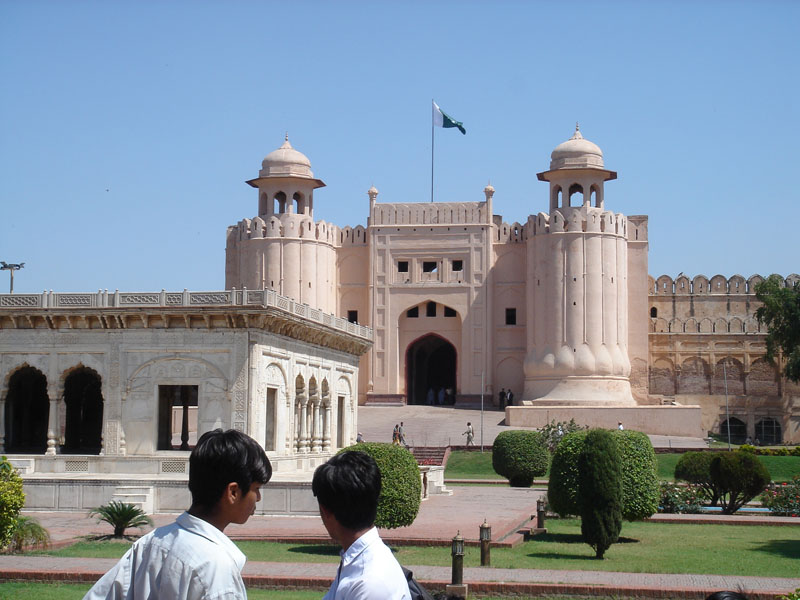
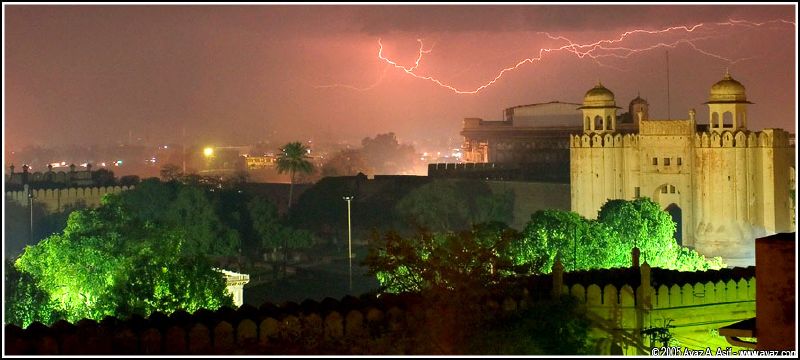
Alamgiri Gate - Main Entrance to Lahore Fort, with Hazuri Bagh Pavilion in foregroundThe Lahore Fort, locally referred to as Shahi Qila citadel of the city of Lahore, Punjab, Pakistan. It is located in the northwestern corner of Lahore, adjacent to the Walled City. Some of the famous sites within the fort are Sheesh Mahal, Alamgiri Gate, Naulakha pavilion, and Moti Masjid. The fort is 1,400 feet long and 1,115 feet wide. In 1981, the fort was inscribed as a UNESCO World Heritage Site along with the Shalamar Gardens.
[edit] Historic Mosques
[edit] Badshahi Masjid
Badshahi MasjidThe Badshahi Masjid (Urdu: بادشاھی مسجد), or the Emperor's Masjid, was built in 1673 by the Mughal Emperor Aurangzeb in Lahore, Pakistan. It is one of the city's best known landmarks, and a major tourist attraction epitomizing the beauty and grandeur of the Mughal era.
Capable of accommodating over 55,000 worshipers, it is the second largest Masjid in Pakistan, after the Faisal Masjid in Islamabad. The architecture and design of the Badshahi Masjid is closely related to the Jama Masjid in Delhi, India, which was built in 1648 by Aurangzeb's father and predecessor, emperor Shah Jahan.
[edit] Wazir Khan Mosque
Gateway to Wazir Khan's Masjid, LahoreThe Wazir Khan Mosque in Lahore, Pakistan, is famous for its extensive faience tile work. It has been described as "a mole on the cheek of Lahore." It was built in seven years, starting around 1634-1635 A.D., during the reign of the Mughal Emperor Shah Jehan. It was built by Shaikh Ilm-ud-din Ansari, a native of Chiniot, who rose to be the court physician to Shah Jahan and later, the Governor of Lahore. He was commonly known as Wazir Khan (the word wazir means "minister" in Urdu language). The Masjid is located inside the Inner City and is easiest accessed from Delhi Gate.
[edit] Data Durbar Complex
View of Jamia HajveriaData Durbar is the tomb of Hazrat Syed Abul Hassan Bin Usman Bin Ali Al-Hajweri, the famous Sufi saint of South Asia, where hundreds of thousands of people come each year to pay their respects and to say their prayers. It is located in Lahore, Punjab, Pakistan. The large complex also includes Jamia Hajveria, or Hajveri Masjid.
[edit] Others
Other well known Masjids inside the Walled City are Suneri Mosque, Masjid of Mariyam Zamani Begum, and Doongi Masjid.
[edit] Havelis
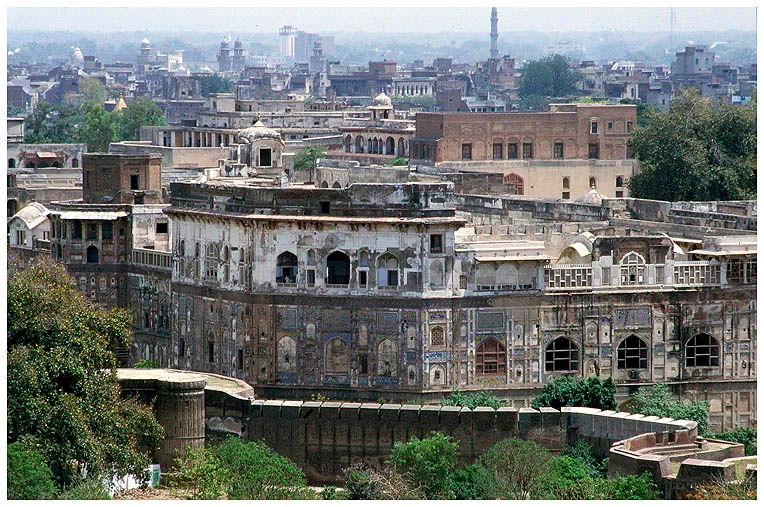
There are many havelis inside the Walled City of Lahore, some in good condition while others need urgent attention. Many of these havlis are fine examples of Mughal and Sikh Architecture. Some of the famous Havelis inside the Walled City include:
Mubarak Haveli
Chuna Mandi Havelis
Haveli of Nau Nihal Singh
[edit] Other Landmarks
Shahi Hamam
Smadhi of Ranjit Singh
Tomb of Malik Ayaz
Alamgiri Gate - Main Entrance to Lahore Fort, with Hazuri Bagh Pavilion in foregroundThe Lahore Fort, locally referred to as Shahi Qila citadel of the city of Lahore, Punjab, Pakistan. It is located in the northwestern corner of Lahore, adjacent to the Walled City. Some of the famous sites within the fort are Sheesh Mahal, Alamgiri Gate, Naulakha pavilion, and Moti Masjid. The fort is 1,400 feet long and 1,115 feet wide. In 1981, the fort was inscribed as a UNESCO World Heritage Site along with the Shalamar Gardens.
[edit] Historic Mosques
[edit] Badshahi Masjid
Badshahi MasjidThe Badshahi Masjid (Urdu: بادشاھی مسجد), or the Emperor's Masjid, was built in 1673 by the Mughal Emperor Aurangzeb in Lahore, Pakistan. It is one of the city's best known landmarks, and a major tourist attraction epitomizing the beauty and grandeur of the Mughal era.
Capable of accommodating over 55,000 worshipers, it is the second largest Masjid in Pakistan, after the Faisal Masjid in Islamabad. The architecture and design of the Badshahi Masjid is closely related to the Jama Masjid in Delhi, India, which was built in 1648 by Aurangzeb's father and predecessor, emperor Shah Jahan.
[edit] Wazir Khan Mosque
Gateway to Wazir Khan's Masjid, LahoreThe Wazir Khan Mosque in Lahore, Pakistan, is famous for its extensive faience tile work. It has been described as "a mole on the cheek of Lahore." It was built in seven years, starting around 1634-1635 A.D., during the reign of the Mughal Emperor Shah Jehan. It was built by Shaikh Ilm-ud-din Ansari, a native of Chiniot, who rose to be the court physician to Shah Jahan and later, the Governor of Lahore. He was commonly known as Wazir Khan (the word wazir means "minister" in Urdu language). The Masjid is located inside the Inner City and is easiest accessed from Delhi Gate.
[edit] Data Durbar Complex
View of Jamia HajveriaData Durbar is the tomb of Hazrat Syed Abul Hassan Bin Usman Bin Ali Al-Hajweri, the famous Sufi saint of South Asia, where hundreds of thousands of people come each year to pay their respects and to say their prayers. It is located in Lahore, Punjab, Pakistan. The large complex also includes Jamia Hajveria, or Hajveri Masjid.
[edit] Others
Other well known Masjids inside the Walled City are Suneri Mosque, Masjid of Mariyam Zamani Begum, and Doongi Masjid.
[edit] Havelis
There are many havelis inside the Walled City of Lahore, some in good condition while others need urgent attention. Many of these havlis are fine examples of Mughal and Sikh Architecture. Some of the famous Havelis inside the Walled City include:
Mubarak Haveli
Chuna Mandi Havelis
Haveli of Nau Nihal Singh
[edit] Other Landmarks
Shahi Hamam
Smadhi of Ranjit Singh
Tomb of Malik Ayaz
Gates of Lahore
Surviving Gates
Name Picture Description
Bhati Gate The entrance to the "Bhati Gate" is located on the western wall of the old city. The area inside the gate is well known throughout the city for its food. Just outside of "Bhati Gate" is the Data Durbar, the mausoleum of the Sufi saint Ali Hajweri (also known as Data Sahib Ganjbaksh). Every Thursday evening Naat Readers and Qawawals (who perform Qawwali) gather here to read Naat and perform religious Qawwali.
Delhi Gate The "Delhi Gate" was once the main and only road that led from Lahore to Delhi. The gate was built during the Mughal era. Although the gate suffered greatly in the 1947 riots, it has since been renovated and today is in its former glory.
Kashmiri Gate The "Kashmiri Gate" is so named because it faces the direction of Kashmir. Inside the gate, there is a shopping area called "Kashmiri Bazaar" and a beautiful girls' college. This college, built upon an old haveli belonging to a shah, is a beautiful example of Mughal architecture.
Lohari Gate The "Lohari Gate" is very close to "Bhati Gate." Like many other gates, it was built to keep enemies out. Although it is now surrounded by shops and stalls, it still has great architectural significance. In Urdu, loha means "iron," and the gate is named Lohari because many lohars (blacksmiths) workshops were based just outside this gate.
Roshnai Gate The "Roshnai Gate," also known as the "Gate of Lights," is located between the Lahore Fort and the Badshahi Mosque. As the gate was one of the main entrances into the city, it was constantly visited by Omerahs, courtiers, royal servants and retinues. In the evenings, the gate was lit up, hence its name. The gate was also referred to as the "Gate of Splendour." It is the only gate that is in good condition and still retains its original looks.
Shairanwala Gate The "Shairanwala Gate," also known as the "Gate of the Lions," was made by Maharaja Ranjit Singh. After its completion, Singh placed two live lions (or Shers) in cages at the gate as a symbolic gesture to warn any invader.
Name Picture Description
Bhati Gate The entrance to the "Bhati Gate" is located on the western wall of the old city. The area inside the gate is well known throughout the city for its food. Just outside of "Bhati Gate" is the Data Durbar, the mausoleum of the Sufi saint Ali Hajweri (also known as Data Sahib Ganjbaksh). Every Thursday evening Naat Readers and Qawawals (who perform Qawwali) gather here to read Naat and perform religious Qawwali.
Delhi Gate The "Delhi Gate" was once the main and only road that led from Lahore to Delhi. The gate was built during the Mughal era. Although the gate suffered greatly in the 1947 riots, it has since been renovated and today is in its former glory.
Kashmiri Gate The "Kashmiri Gate" is so named because it faces the direction of Kashmir. Inside the gate, there is a shopping area called "Kashmiri Bazaar" and a beautiful girls' college. This college, built upon an old haveli belonging to a shah, is a beautiful example of Mughal architecture.
Lohari Gate The "Lohari Gate" is very close to "Bhati Gate." Like many other gates, it was built to keep enemies out. Although it is now surrounded by shops and stalls, it still has great architectural significance. In Urdu, loha means "iron," and the gate is named Lohari because many lohars (blacksmiths) workshops were based just outside this gate.
Roshnai Gate The "Roshnai Gate," also known as the "Gate of Lights," is located between the Lahore Fort and the Badshahi Mosque. As the gate was one of the main entrances into the city, it was constantly visited by Omerahs, courtiers, royal servants and retinues. In the evenings, the gate was lit up, hence its name. The gate was also referred to as the "Gate of Splendour." It is the only gate that is in good condition and still retains its original looks.
Shairanwala Gate The "Shairanwala Gate," also known as the "Gate of the Lions," was made by Maharaja Ranjit Singh. After its completion, Singh placed two live lions (or Shers) in cages at the gate as a symbolic gesture to warn any invader.
Subscribe to:
Posts (Atom)